If you are planning an upcoming leadership transition, don’t shut off your executive visibility strategy. A leadership transition requires executive reputation management for the incoming and outgoing leader.
No matter the size of your company, leadership transitions are inevitable, but a proactive strategy will mitigate reputation risk.
Why Executive Reputation Matters During Leadership Transitions
A leader’s reputation has a direct impact on a company’s reputation and valuation. Executives estimate that 44% of their company’s market value is attributable to the reputation of their CEO, and they attribute nearly half of a company’s reputation to its CEO’s reputation.
We can no longer separate the company’s brand from that of its leaders. Just look at the media attention surrounding Apple’s newly appointed CEO. John Ternus has worked at Apple for 25 years, and the fact he has zero posts on LinkedIn made headlines everywhere from Fortune to New York Times to Reddit.
Apple is undoubtedly one of the strongest brands in the world, and we still gravitated to the incoming CEO’s lack of a public executive reputation. That playbook might work at Apple (I still have my doubts), but I guarantee it is the wrong move for the rest of us leaders and businesses that lack the Apple prestige.
Build Trust Before You Need It
The biggest objection I hear from founders and CEOs about building an executive reputation is that you become the business’s identity, and if you ever plan to leave, you are putting the business at risk.
In fact, an established executive reputation by the leader transitioning will help the organization and its key audiences – employees, customers, shareholders – through the transition.
A strong executive reputation can’t be built overnight. Start building today.
Key strategies
- Define the leader’s messaging and voice
- Develop thought leadership content through authored articles and blogs
- Utilize strategic LinkedIn content
- Audit their digital presence and AI search visibility
You also shouldn’t wait to start building the incoming leader’s executive reputation. As soon as the person is identified, regardless of the timeline, the same key strategies should be used to ensure when you are ready to announce, the new leader is searchable and credible.
During the Transition: Own the Narrative
Regardless of whether you have a new leader identified or not, be prepared to own the narrative.
Think about your key audiences and how this news might impact them. What questions will they likely have? No matter how you plan to deliver the news, write out what you want to say. Try to answer as many potential questions or concerns in your initial messaging as possible.
Then think about your timeline, and make sure you prioritize your internal audience (employees) first. Lay out who hears what, from whom and when. Consider key business relationships that may need a more personalized delivery. Remember that news like this often travels fast.
Ensure your key messages are consistent with each of your audiences, in every communication and on all platforms. Provide other leaders with talking points, paying close attention to middle managers who often get the most questions.
Make sure you have a plan in place to monitor coverage or chatter, especially on social media, online platforms like Reddit and media coverage.
As you are creating your communications plan, these are some of the most overlooked, but important channels to consider:
- Press release
- Company LinkedIn
- Company website
- Company social media
- Incoming and outgoing CEO social media
- Media interviews
After the Transition: Strengthen the New Leader's Reputation
To set your new leader up for success, a strong executive reputation plan must be in place.
- Determine how and when to communicate the new leader’s vision.
- Ensure all public profiles are updated and consistent. (AI dislikes inconsistency!)
- Build credibility through authored articles and earned media.
- Utilize social media and blogs to reach and engage ideal audiences
- Audit the executive’s AI search reputation
Reputation isn’t established in one announcement. It needs to be reinforced through ongoing visibility.
A proactive reputation management strategy for the incoming and outgoing leader will pay dividends. Typically we see greater employee confidence, stronger investor trust, better media coverage, more favorable narratives online and improved AI search visibility.
An upcoming leadership transition is not a time to go dark. It’s the time to ensure trust and credibility are on solid ground.
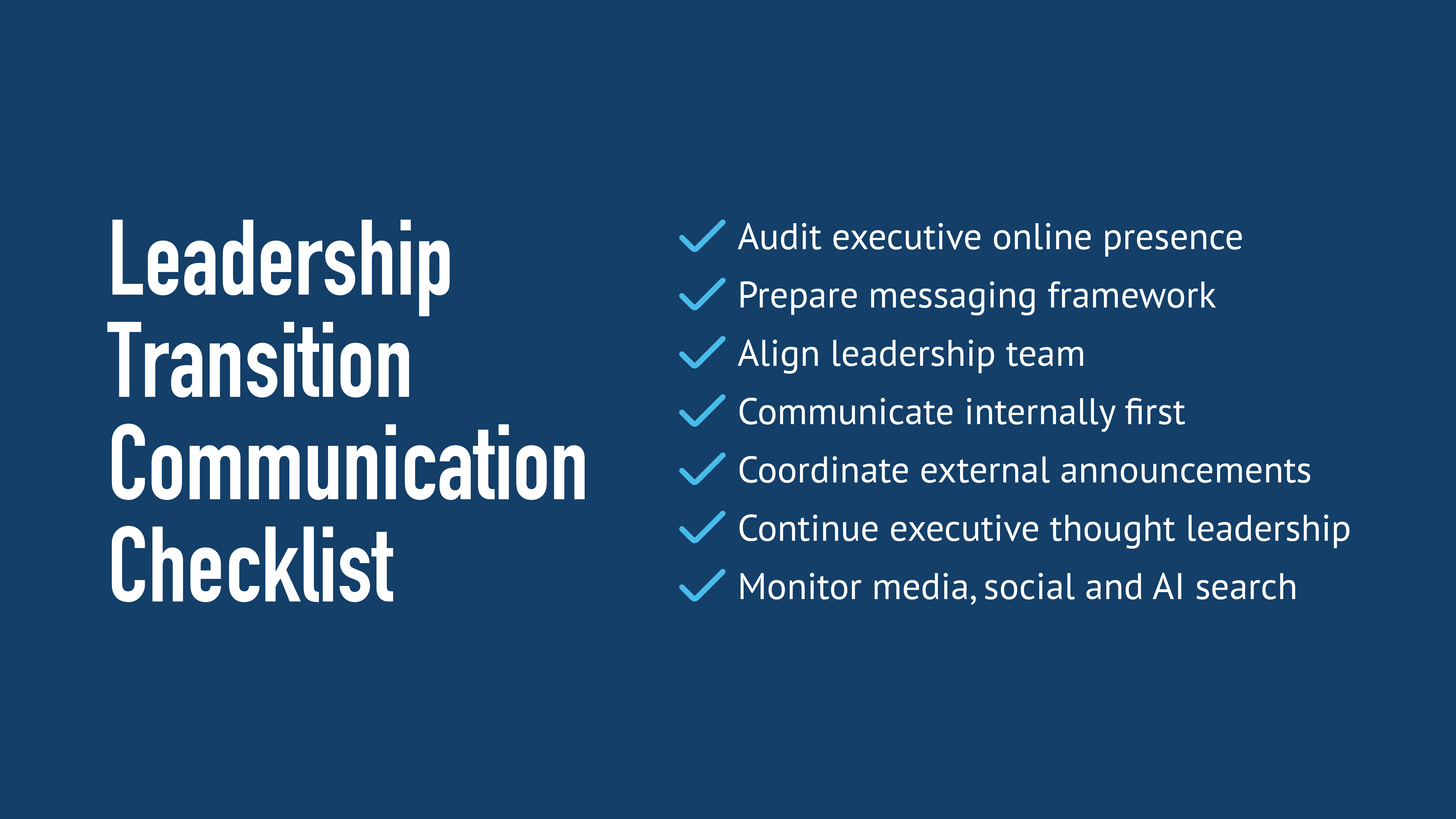
Key Takeaways
- Successful leadership transitions can’t begin with the announcement or end after the first week on the job.
- The most successful transitions begin with an investment into an executive’s reputation long before a transition is in motion.
- Every interview, LinkedIn post, media mention and AI-generated answer contributes to how stakeholders perceive both the executive and the organization.
- By investing in executive reputation management before, during and after a transition, organizations can build trust, reduce uncertainty and position new leaders for long-term success.
Executive Reputation for Leadership Transitions FAQ
What is executive reputation management?
An executive’s reputation is directly tied to company valuation, investor confidence, employee engagement and brand trust. In the era of AI search, where reputation is summarized in just a few sentences, it’s the proactive strategy to safeguard and control the online narrative.
Why is communication important during a leadership transition?
Transitions can be a time of uncertainty. Trust and transparency go a long way in ensuring key stakeholders have the information they need to buy into the future.
What should companies do before announcing a new CEO?
Audit the new CEO’s online and AI reputation and begin investing in building their executive reputation.
How can executives protect their reputation during a leadership change?
Stay visible. Don’t shut off your executive visibility strategy before or during a leadership transition.